Sunday, January 18, 2015

Amigurumi for Christmas

This Christmas, a lot of my amigurumi made their way under the Christmas tree.  I've already posted about a bunch of them, but I realized that I have even more to share!

I crocheted this Dorothy & Toto from the AmiguruME book, which is an incredibly amazing collection of patterns to mix & match to make whatever kind of human amigurumi you want.  The author, Allison Hoffman, even includes a few little animals (like the dog I used for Toto).  Her patterns are written perfectly and it is so easy to navigate your way through the book and combine the various patterns.  Dorothy & Toto were a gift for my beloved niece, Charlotte, and I think she really liked them!


I'm still not 100% happy with how the smile turned out.  Niki, if you think it doesn't look charming enough, rip that smile out and embroider a new one with some red floss!  I used red crayon to give Dorothy her little blush.  Sonia was absolutely tickled by the fact that I colored with crayon on this amigurumi! You can't tell in these pictures very well, but I used Red Heart Shimmer for the ruby slippers, so they sparkle just a bit.


Isn't Toto handsome? I love his little nose.


This USS Enterprise (from Star Trek) was made for my friend's husband, and when I set out to find a pattern, I asked my friend which Star Trek series her husband preferred.  He, like me, prefers Star Trek: The Next Generation, but I couldn't find any patterns for that version of the Starship Enterprise (the NCC1701-D).  I didn't have time to design my own pattern, so I went ahead and crocheted an NCC1701 from a really great free pattern and just used slightly different colors to style it more like the NCC1701-D.  I think it turned out really cute!

(just ignore the fact that you can see my trash and recycle bins in this picture)


My nephew, Nicholas, received this Mario for Christmas.  I was really happy with the pattern (Wolfdreamer is my pattern-writing hero!!), but my yarn choices caused Mario's head to be too small in comparison with the hat.  Weirdly, worsted weight Red Heart Super Saver yarn differs in thickness from one color to the next, and the Cherry Red is significantly thicker than the Buff (which I used for the skin color).  So, if I do this pattern again, I will increase the size of the head to compensate.


Sonia is not a fan of the eyes....  She actually used the word "freaky" when she first saw the finished Mario.  I used felt for the eyes, as was called for in the pattern, and I am just not good at crafting eyes out of felt.  Oh well.

The hat is so perfectly designed!!!  I had to see if Bobo Cat would look good in it.  He, as usual, was not impressed.


And finally, the pièce de résistance, Jordan's motorcycle and cat!


I used Ana Yogui's absolutely perfect pattern to create a motorcycle similar to the one that Jordan himself rides, The Displacement.  Because I left off the sidecar part of the pattern, I had to use toothpicks to help this motorcycle stand up for its glamour shots.


Jordan says he has plans to suspend this motorcycle from the ceiling (kind of like a mobile) in the future.


The cat's goggles turned out a bit odd-looking due to my color choice (it probably would have looked better with a darker color of blue, or perhaps gray).  But other than that, I'm happy!


Friday, January 16, 2015

The 2014 Afghanpalooza

Even though I swore off crocheting afghans many years ago (so much time! so much money to buy the yarn! so much boredom with doing the same pattern over such a large area!), I managed to crochet not one... not two... but THREE afghans in 2014!  Well, two and 9/10ths, anyway.  I finished up the last bit of the third afghan just yesterday, but it's barely 2015, so I think that counts.

The first afghan I finished in 2014 was the last one that I started....  Even though I had been working on the Moogly Crochet-a-long all year, I couldn't resist jumping into one more CAL in November.  One of my favorite crochet pattern designers (whom I had discovered through the Moogly CAL), Margaret MacInnis, hosted a mystery CAL for her new afghan pattern.  A mystery CAL is fun because you buy your yarn based on some hints provided by the designer, and then you crochet bits and pieces of the project without knowing until the very end what it's going to look like!  You definitely have to place a lot of trust in the designer.  I think this "Maggie Muggins Mystery CAL Afghan 2014" turned out great!!  I made it for Niki & Corey, so I let them choose the colors (didn't they do a great job?).


I helped test the pattern for Ms. MacInnis, and it was so much fun talking with the other crocheters on Ravelry as the mystery CAL unfolded.  Right before I finished the last couple of rounds of the border, I caught Margie Cat lounging on the afghan (which is more of a "lapghan" size)....


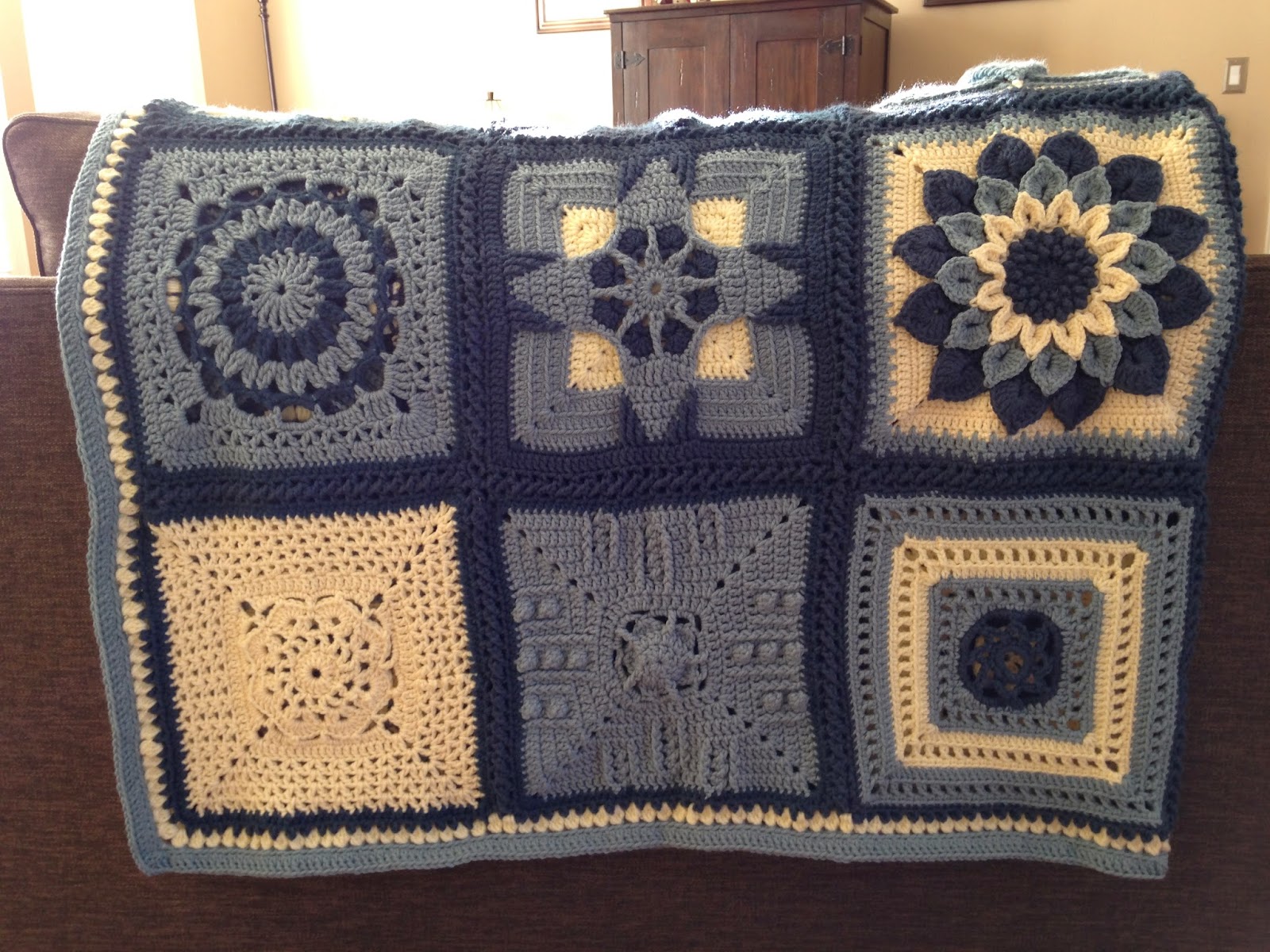
My other two afghans were the result of the amazingly fun Moogly CAL 2014.  I was having such a great time crocheting the 12" blocks that I kept doing "extra-curricular" blocks in addition to the official CAL ones.  By August, it was clear that I was going to have too many blocks for one afghan, so I decided to make two: one for Andrew and me, and one for my sister- and brother-in-law.  Without further ado, here are the finished products!

Ali & Daniel received this afghan for Christmas:


Andrew and I kept this bad boy for ourselves:


Apologies for the poor quality of the pictures....  Due to their sheer size (around 6.5' x 4.5'), it is incredibly difficult to get good pictures of afghans!

Spread out over one year, crocheting my two Moogly CAL 2014 afghans didn't seem to take horribly long or cost too much, but when I crunch the numbers....

- Crocheting one 12" block: 2-4 hours (let's say an average of 3 hours)
- Joining the blocks using the flat braid join: 2 hours to join 6 blocks
- Working one round of border (each afghan had three rounds of border): 2 hours

During 2014 (and the first 2 weeks of 2015), I spent 172 hours on these two afghans.  ONE HUNDRED SEVENTY-TWO HOURS.  Whoa.  That's 86 hours per afghan.

Each afghan took about 6 one-pound skeins of Caron One Pound acrylic yarn at about $7 per skein.  Most of the patterns were free, but I splurged and spent about $6 on patterns for each afghan.  So, I spent a total of $96, or $48 per afghan.

Would I do another CAL?  Most definitely!!  But I need to take a break and finish some baby gifts, commissions, and some other items.  Plus, I'm trying to learn how to knit!  I know, I know, flying pigs are being spotted everywhere.....  I'm not sure if I'd do another "sampler"-style afghan where every single block is a different design.  It's fun not crocheting the same design over and over, but even when you use the same colors in each block, it's still not very cohesive.  I think I like the look of Niki & Corey's MMMCAL afghan slightly better than the Moogly CAL afghans.  But I still love all of my afghan babies!  And let me tell you, the huge Moogly CAL afghans are SO WARM.

Hurray for afghans!

Monday, January 12, 2015

Tough new Transformers Rescue Bots basket

Peter's Transformers Rescue Bots collection has long since outgrown the bag I made him to hold it.  An old tutorial from Crafty Hipster suddenly came across my Pinterest page and I instantly knew that it was the answer.  How had I never seen this tutorial before?  So much for my assertion that there aren't any tutorials out there for fabric baskets with piping.  (To be fair, this one was on an obscure blog that hasn't been updated in a year and a half.)


I absolutely loved sewing this basket, because it used a construction technique that isn't common to fabric basket making.  Instead of boxing out the corners, the sides and bottom of the basket are one continuous piece (like a gusset in a bag).  This allows for piping to be added with ease.    Here is a side view:


Because this basket was going to hold a buttload of Rescue Bots, I actually added a layer of Peltex inside on all sides as well.  Some extra stitching around the top of the basket helps hold this in place, because otherwise it would just be loose inside.  I waited until the exterior and the interior were joined, and then inserted the Peltex pieces through an extra-large turning hole.


For the handles, I took some nylon webbing that I had salvaged off of a bag I took apart a while back.  On its own it was floppier than I would have liked, but I doubled up the pieces and stitched them together.  Now they stand up nicely and feel extra sturdy.  I also fussy-cut the fabric so that each side features a different figure from the Transformers fabric.  Since the fabric was directional, I had to cut the exterior sides and bottom piece (the one that is continuous like a gusset) in two pieces and sew them together facing opposite directions.  Otherwise one side would have had an upside-down Transformer.


I would make this basket again and again.  The Peltex made it more difficult to work with in the end, but otherwise the basket was awesome.  Peltex is my favorite frenemy for sure.  I complain endlessly about sewing with it, but nothing else will substitute for it.

Too bad the gargantuan new Optimus Prime doesn't fit in there.  He will just have to guard over the rest of his crew.


What do you think, Optimus?  Does it meet with your approval?


(I think that was a yes.)

________________________________________________

Linking up to: Gingerly Made

Monday, January 5, 2015

Shredded Heart T-shirt -- Sewing Tutorial


I know Valentine's Day is still a month away, but I couldn't resist making Charlotte (my six-year-old) a new shredded heart t-shirt to replace the one she has just about worn to death over the past two years.  My brother-in-law once asked Charlotte if she had been attacked by a vampire what she was wearing it, but she just giggled and ran away.  Let's hope no one else mistakes little Charlotte as a vampire's victim when she wears this new shirt.

The tutorial for this is so simple that I could probably just post a series of photos without text, but I have a few tips along the way that I learned after making a couple of these.  This is kind of a form of reverse appliqué, I suppose, but don't quote me on that.


Shredded Heart T-shirt -- Sewing Tutorial

Materials Needed:

Store-bought t-shirt, pre-washed
Shiny fabric (a light- to medium-weight scrap as big as the chest area of the shirt is plenty)
Thread to match the t-shirt (although a contrasting color might look cute too)
Ball point or stretch needle
Paper
Small, sharp scissors
Pinking shears (optional)


STEP ONE: Making the pattern and marking the stitch lines

Grab a standard-sized sheet of paper and fold it in half with the shorter sides meeting.  Dig deep into the skills you honed in elementary school and draw half of a heart (against the fold, of course) that is a little less than half the width of the chest of the t-shirt, and just about the height of the paper.  Cut it out, open it up, and check to make sure it will fit the front of the shirt.  Make sure there are a couple of inches on each side to account for the shirt curving around the sides of the torso.


Take a pencil (or one of those fancy disappearing fabric pens) and trace around the heart.


Use a ruler to draw parallel diagonal lines across the heart.  I made mine an inch apart, but I might make them a bit closer next time I make another shirt.  Come to think of it, this would make a good present for each of the birthday parties Charlotte is invited to over next couple of weekends . . .


STEP TWO: Pinning and stitching the shiny fabric to the t-shirt

Cut a scrap of your shiny fabric that is a few inches larger than your paper heart on all sides.


With the RIGHT side of the shiny fabric facing the wrong side of the front of the shirt (inside the chest), pin the fabric carefully around the heart and in between each of the diagonal stitching lines.  Yeah, it looks like a pin cushion exploded onto the t-shirt, but trust me -- the knit fabric of the t-shirt and the shiny fabric on the inside will want to shift around a lot.  Pin them into submission.  Don't let that fabric boss you around.


For this next part, I actually used my new walking foot just to try it out.  You totally don't need a walking foot though.  The first shirt I made for Charlotte a couple of years ago was sewn without a walking foot, and it turned out great.  Just make sure you are using a ball point or stretch needle, and that you make any necessary adjustments to your settings on your machine (if you have them).  Practice with a scrap of t-shirt fabric with some of the shiny fabric underneath and make sure you have it figured out before you start tearing up the shirt with the wrong settings!

First, stitch all the way around the heart.  Then stitch down all of the diagonal lines, one by one.  Make sure to do a lock stitch at the beginning and end of each diagonal.  Start each diagonal from the same end -- it doesn't matter whether you always start at the top or always start at the bottom if you make sure to be consistent.  It doesn't have to be perfect without any ripples, but try your best to stitch neatly.


STEP THREE: Shredding the heart

Okay, so maybe we're not so much "shredding" the heart as we are taking small, sharp scissors and caaaaaaaarefully snipping between each stitch line.  You're just cutting the t-shirt though -- don't cut the shiny fabric underneath and definitely don't cut all the way through back of the t-shirt.  Let's keep it civilized here.

Make a teeny snip in the t-shirt layer ONLY, just inside the heart-shaped stitch line between the diagonal stitch lines.  Then, staying roughly in the middle, snip all the way to just inside the other side of the heart-shaped stitch line.  Go slowly and don't get too excited.  You don't want to snag the shiny fabric.


See the shiny side of your fabric peeking through?


Repeat between all of the diagonals, until it looks like this:


STEP FOUR:  Finishing up

Flip the shirt inside out.  Grab some pinking shears (or your regular scissors) and cut off the excess shiny fabric to about 1/2"-3/4" outside the heart-shaped stitching line.  It's going to look all rough and nasty inside, but no one will ever see this part and it has never irritated my daughter's skin.


Wash the shirt again to get rid of all of the teeny threads that will work their way off of the pinked edges of the shiny fabric.  This will also make the cut edges of the t-shirt knit to roughen up and get wavier.

And there you have it!  Your child can look like she was attacked by a vampire too.  Ahem.


Uh oh -- I actually found the photo I had posted on the blog a couple of years ago when I made Charlotte's first shredded heart t-shirt.  The gray shirt with the red shiny fabric underneath looked really cool.  I do not, however, have any idea why my children were hanging around with what appear to be pairs of Charlotte's underpants on their heads (not to mention Peter's shirt being inside out and backward).  My kids are so strange.


______________________________________________


Sunday, January 4, 2015

Christmas chevron runner

Can someone please tell me whether this is a table runner, a table topper, or what?  I have no idea what to call these little shortie table runners that I make.  If a table runner is running a marathon, these shortie ones I make are just running sprints.  I like them a little shorter for use on my kitchen island so we're not constantly having to remove them.  Here's the latest one I made from a remnant that caught my eye at the fabric store:


I'm really bummed that I have to put this away with the rest of the Christmas decorations, but it will be really fun to bring it out next December.  I used the backing (which was cut from an old tablecloth) also as the binding using my favorite tutorial from Cluck Cluck Sew.  The cloth was probably a bit too thick to be doing it that way, but I forged ahead and forced it into submission at the mitered corners.  I used felt as the batting.

The most exciting part of the project (and what was actually the whole reason I tackled it) was that I was able to use my brand-spankin' new walking foot for the quilting.  You might ask "what quilting?" because it's pretty subtle.  I just used off-white thread and followed the edges of the off-white chevrons.  I didn't want to distract from the pattern of the fabric, and I was pleased with the result.  The walking foot is awesome, and I can't wait to use it again.

I have a bit more of the fabric and I'm thinking of sewing up a quick piped basket to throw in with the Christmas decorations since I gave away all of the piped baskets I made last month.

Thursday, January 1, 2015

Toy Tote -- Sewing Tutorial


All kids need a way to carry the myriad toys they insist on bringing everywhere they go.  This toy tote is the perfect size for a half a dozen Rescue Bots, a herd of My Little Ponies, or enough small Beanie Boos to keep a kid entertained for well, at little while at least.

The finished dimensions of the tote are approximately 11" high, 8" wide, and 8" deep.

Toy Tote -- Sewing Tutorial

Materials Needed:

Exterior fabric: 1/2 yard if non-directional print, 3/4 yard if directional print (quilting cotton or lightweight home decor)
Lining fabric: 1/2 yard if non-directional print, 3/4 yard if directional print (quilting cotton)
Felt or fusible fleece
1" wide webbing: 18" long (cotton or nylon)
Cording: 68" (nylon or cotton)
Thread: to match both exterior and lining fabrics
Freezer paper (or regular paper): at least 8" x 18"


Seam allowances will all be 1/4" unless otherwise noted.  


STEP ONE: Drawing the pattern and cutting the fabric

The pattern piece is basically an 8" x 18" rectangle with the bottom corners cut off.  The easiest way to create this is to:
  1. Draw an 8" x 18" rectangle.
  2. Mark a point at the center of the bottom short side (4" in from both sides).
  3. Mark points 14" down on each of the long sides.  Connect each of the long side points with the bottom center point.
  4. Cut along those diagonal lines to chop off the little triangles.  You should be left with a shape that looks like a fat pencil.
  5. At 3" down from the top and at 6" down from the top, draw lines parallel to the short sides.  Don't go crazy and cut on those lines just yet though.
Honestly, it's probably just easier to show you a diagram.  Aren't my drawn-on graphics AMAZING?


Here is a closer shot of the tip of the triangle (with an unnecessary marking whited out).


Once you have your pattern piece all squared away, iron it onto (if you used freezer paper) the LINING and cut FOUR of these shapes.  I like to fold the fabric such that I only have to cut once to get all four pieces.  If you do this, just be careful that you keep the direction of the print in mind.  The point on the pattern piece should be pointing down.  

After you cut the lining pieces, chop 3" off the pattern piece at the first horizontal line you drew.  Then, use the pattern piece to cut out FOUR of these shapes from your EXTERIOR fabric.  

Chop off another 3" from the top of the pattern piece (at the second horizontal line you drew) and cut FOUR of that shape from your FELT/FUSIBLE FLEECE.

You should have this now:


STEP TWO: Sewing the body of the tote

Adhere the felt/fleece to the wrong sides of the exterior fabric, matching the tips of the points.  I spray basted my felt to the fabric, but ironing on fusible fleece would have been even easier.  You could also just machine-baste the felt/fleece by sewing down the edges to the points.


Next, cut your webbing into two 9" lengths.


On the right side of one of the exterior pieces, measure down 4" from the top and align the top edge of the strap at that point.  Match the raw end of the webbing with the left raw edge of the exterior piece (the right side will hang over by an inch for now).


Take a second exterior piece and lay it face down on top of the first piece (right sides facing each other).


Pin (or use the fancy new Wonder Clips you got from your sister for Christmas!) along only the left side, all the way down to the point.


Repeat those steps with the other two exterior pieces and the second piece of webbing.


On both of these, make a mark 1/4" up the left side from the tip of the bottom point.  This will be where you START stitching.


Thread your machine with a color of thread that blends well with your exterior fabric.  Starting at the mark you made on the point, stitch all the way up the left side only.  Do not stitch across the top or down the right side.


Closer look at how the stitching at the bottom point should look.


Repeat with the second set of exterior pieces.  Then open them with the right sides facing up and the webbing draped to the left.  You should have this now.


Flip one horizontally over on top of the other (keeping the webbing in place).  The webbing pieces should now be sticking out in opposite directions.  If they aren't, then switch one of them so they are. Match the bottom points and the other corners on the raw edges.


Before you pin them together, measure down from the top on each side 4" and make sure the other ends of the webbing are in place.  Then stuff those ends in a bit to align the raw edges of the webbing pieces with the raw edges of the fabric pieces.  Pin into place on both sides.


Pin the raw edges together down both sides (leaving the top open).  At the bottom point, flatten out the sewn seams like this:


Sew each side separately, starting at the top and stitching down until you reach the bottom point.  Flatten out the point and pull the seam allowances back to get as close as possible to the existing stitching lines.  Once you have sewn down both sides, you should have this:


If you open it up and peek inside, you should have this:


Before you flip the exterior right side out, trim a bit at each of the corners.  Don't worry about trimming at the bottom point -- the bulk isn't really that crazy and it's probably not a good idea to weaken that juncture unnecessarily.


Flip the exterior right side out and marvel at how cute it's looking!


STEP THREE: Sewing the lining

This is pretty much identical to the process for the exterior, but you don't have to worry about any pesky webbing.  Take two pieces and place them right sides together.  Repeat with the other two pieces.  Pin down one side.  I went wild and pinned down the right side (instead of the left side like I did with the exterior pieces).


Mark that 1/4" point just up from the point and stitch down the right side to that mark. Do this with both sets.


As with the exterior, open these up and pin them right sides together (matching at the point and each of the corners).  Sew down both sides separately, stopping when you get to within 1/4" of the point.  Do not sew across the top.  When you have done that, you should have this:


STEP FOUR: Assembling the tote

Keep the lining with the pretty side facing inward, but open it up and flatten out the bottom.  With wrong sides facing, nest the lining inside the exterior.  Match up the seams on the sides and bottom corners.  The lining will stick up 3" taller than the exterior.


Before pinning it all the way around, measure to make sure the lining sticks up exactly 3" all the way around.  Adjust if necessary and pin into place.  Do this at the seams and in between as well.


Sew the exterior to the lining all the way around 1/4" from the top raw edge of the exterior.  Make sure you do this in a color of thread that matches the lining, because this stitching will be visible from the inside of the tote.


STEP FIVE: Creating the casing for the drawstrings

Fold and press down the lining down to the outside (wrong sides together) so that the raw edge of the lining meets the raw edge of the exterior all the way around.


Fold it down again (and press) at the point where the raw edges meet, covering the stitching line.


This is what it should look like now -- about 1 1/2" of the right side of the lining showing on the outside.


On the inside, you can see the stitching line from when you sewed the exterior to the lining.  It should be about 1/4" down from the top.  From the inside, stitch right over this line again.  (You could just stitch from the outside 1/4" down from the top and trust that you will stitch exactly on this line, but I'm not that great at keeping a consistent seam allowance.)


Once you have stitched around the top, it should look like this from the outside.


Now stitch around the top again, this time 1 1/4" from the top (which is 1" down from the existing stitch line).  The easiest way to do this, actually, is to just stitch around again 1/4" up from the bottom if the folded lining.


Now the top of your bag should look like this from the outside.  (Yes, my machine is having some issues keeping a consistent tension and I'm taking it in for service ASAP!)


STEP SIX: Adding the drawstrings

Grab your handy dandy seam ripper and carefully unpick the stitches at one of the seams between the two stitching lines on the outside of the tote.


Pick out the teeny threads or snip them really closely.


Locate the same spot on the opposite side of the tote (diagonally across).  Rip out those stitches between the stitching lines as well.  Sometimes it's hard to get started, but if you pull at the seam a little, it exposes the stitches enough to get your seam ripper under one.  Once you have one stitch picked, the others are a lot easier.


Grab your 68" of cording and cut it in half.  I used nylon cording that is a little thinner than parachute cord.  The best way to make sure it doesn't unravel at the ends is to melt them a little with a flame.  I never realized how often I would use my little kitchen lighter thing in sewing, but it comes in handy to melt the ends of cording, the cut edges of ribbon, the cut ends of zippers, etc.  I couldn't figure out how to do this while taking a photo, so you'll just have to trust me that those little ends were melted properly.


Attach a safety pin to the end of one of the strings, then stick it in one of the holes you just made in the casing.


Work it all the way around and back out the same hole you went in.  Tie them together.


Grab your other piece of cording and do the same thing in and back out of the other hole you made on the opposite side.  Tie those ends together as well.  Now you have two drawstrings that can be pulled in opposite directions to shut the tote.  This is much easier for little kids to handle than working a drawstring stopper.


Voila!  A great little toy tote for transporting all those treasures.  I made this one for my daughter's magic tricks.  She just got a bunch of them for Christmas and has grand plans to take her show on the road.


One of the best features of the bag is that it can stand open on its own while the kids load and unload their toys.


And it looks kind of cool from the top when you look inside!


[It's no secret that I love the Drawstring Tidy Caddy from the awesome and amazing book Fabric-by-Fabric One-Yard Wonders that Erin got me a few years ago.  I have never actually followed the instructions for that bag as they were written, though.  By the time I added all the different features I wanted to the bag, I realized I needed to memorialize my version so I would remember how to do it next time.  Please do go out and buy that book for all of the other projects in it (like the adorable Playdate Frock, and the super-functional Bag Holder), and perhaps you would like their version of this tote much better!  This is just my tutorial on how to make my take on a tote with the same basic structure.  For more on the concept of creative process, I love this post on the topic by Deanna of Sew McCool.]

-----------------------------------------------------------------------

Featured at: Totally Tutorials, Sew Pretty Sew Free, Sugar Bee Crafts, Threading My Way, And Sew We Craft, The Crafty Blog Stalker

Linking up to: Threading My Way, Pretty Pintastic Party, I Heart Nap Time, Sew Can She, Gingerly Made, Reviews Chews & How-Tos, Flamingo Toes, Creating My Way to Success, Scattered Thoughts of a Crafty Mom, Sew Can Do, ChrisW Designs, Modern Tradition Quilts, Blossom Heart Quilts, The Silly PearlMaybe She Made It, Sugar Bee Crafts, Sweet C's Designs, Nap-Time Creations, Sew Fresh Quilts, Fine Craft Guild, Someday Crafts, Ginger Snap Crafts, Smart School House, The Life of Jennifer Dawn, A Glimpse Inside, Saving 4 Six, Fort Worth Fabric Studio, Diana Rambles, Straight Grain, The Better Half, Just Us Four, The Crafted Sparrow, Reasons to Skip the Housework, Uncommon Designs, Skip To My Lou, Tiny Sidekick, Quilt Story, I Have To Say, Funky Polkadot Giraffe, The Stitching' Mommy, One Krieger Chick, The DIY Dreamer, Sew Many Ways