Tuesday, January 14, 2014

Melissa's Boot Cuffs

My friend, Melissa, mentioned to me that she had always wanted some boot cuffs (I've also seen them called boot toppers), which mimic the look of cool thick socks with decorative tops sticking out of your boots.  But, unlike thick socks, these cuffs only cover the part of your leg from mid-calf to right below your knee (or wherever your boots end), so they don't make your feet hot or your boots feel too tight.  I had seen a ton of patterns for boot cuffs/toppers floating across some Pinterest boards that I follow, so I told her I'd give it a whirl. The free pattern that Melissa chose (Belmont Boot Toppers) was so cool that I decided I needed a pair, too!  So, I called this post "Melissa's Boot Cuffs", but the pictures are actually of the pair I made for myself.


Each cuff took about an hour and 15 minutes to make, I think.  These are the large size, so they have 4 rows of scallops, but Melissa's are the small size (which I haven't taken glamor shots of, so they are not pictured), so they only have 3 rows.  Both look cool to me!


I promise to coordinate with you, Melissa, so we don't accidentally wear our boot cuffs on the same day and look like we're trying to be twins!  My actual twin might take umbrage.

Monday, January 13, 2014

Floating Inset Pocket with Piping -- Sewing Tutorial


This pocket is great for the outside of a lined bag to hold something fairly big that you need quick and easy access to on a regular basis.  Think sippy cups, sunglasses case, cell phone, etc.  I used some scrap fabric to illustrate the pocket for the purposes of this tutorial, but it's not hard to imagine how it might work with a lined tote bag or handbag.

Floating Inset Pocket with Piping -- Sewing Tutorial

Materials Needed:

Outside fabric (the side of a bag that you're making)
Coordinating lining fabric (for the inside of the pocket, but will show on the outside, too)
Piping
Thread to match the piping
Zipper foot or piping foot
Seam ripper


STEP ONE: Preparing the piping

Determine the size and shape of your pocket.  I like making it an oval shape, but a circle would be cool, too.  I guess you could even go crazy and make it wavy, but that's totally up to you.  Lay out your piping in the desired shape and make sure there is about a 1" overlap of the beginning and end of the piping.  Cut off any excess.  Your lining fabric should be cut about an inch or so wider on either side than the pocket opening, and the length of the lining should be as deep as you desire, including about an inch above the top of the opening.


Using a seam ripper, remove the basting on the piping on the last inch.


Open the piping up and cut about an inch off of the length of cording inside.


Press the end down about 1/4" toward the inside of the piping.


Making sure the piping isn't twisted, nestle the other end of the piping inside the open end, butting the intact end up with the cording inside the open end.


Pin it together.


Put your zipper foot (or piping foot, if you have one) on your machine.  This is what mine looks like for my Viking, but my old Brother machine had one that looked quite a bit different.


Baste the circle of piping together along the original basting line.


STEP TWO: Stitching the piping in place

Pin the piping in place on the right side of the outer fabric, with the raw edge of the piping FACING IN.  It's going to be all wavy and obnoxious around any tight curves, but don't worry too much about that and just make sure the round part of the piping is lying nice and flat against the outside fabric.


With your needle in the far left position, sew counter-clockwise around the inside of the piping.  Sew right on top of the basting that holds the piping together.  Go slowly, because the stitching line you make that shows on the back is very important in the next step.


STEP THREE: Sewing on the lining

Lay one piece of the lining fabric on top of the piping you just sewed, with the right sides of the fabric together.  Make sure there is about an inch of lining above and on both sides of the piping circle.  Add a couple of pins in the corners of the lining fabric (not pictured) to keep the lining in place.


Flip the whole thing over so that the wrong side of the outside fabric is now facing up.  Add a few pins around the outside of the stitching line to ensure that the lining is secured to the outside fabric close to the piping.  Then, from the inside of the circle, stitch right on top of the existing stitching line.  Again, go slowly because accuracy is very important to the finished product.


If you flip the whole thing over again, it should now look like this.


STEP FOUR: Cutting and flipping

Cut out the shape of the pocket about a 1/2" INSIDE the stitching line.


Add a few small snips along the curves, cutting through all of the layers, almost up to (but not through!) the stitching line.


With the right side of the outside fabric facing up, stuff all of the lining fabric into the hole and through to the other side.


It should look like this now, and the wrong side of the outside fabric should be facing the wrong side of the lining fabric.


Do some "persuasive ironing" to get the lining to lie flat and to get the front side looking nice and unwrinkled.  Steam the heck out of it if you need to.


The back might not look perfect but don't stress about that too much.  The front is what counts.


NOTE: If you would like to add some topstitching around the outside of the piping, do it now!  I chose not to do it for the purposes of this tutorial, but it definitely looks nice.  If you have fancy pattern stitches on your machine, this would also be a great place to add them.


STEP FIVE: Assembling the pocket lining

With the right side of the outside fabric facing down, lay the other piece of lining right on top of the piece already sewn on, with the right sides facing.  Line up all the raw edges and pin only the two layers of lining together.  I pulled the outside fabric out of the way to show that it wasn't pinned to the lining.


Put the regular foot back on your sewing machine.  Then, sewing ONLY through the lining layers (pulling the outside fabric out of the way as you go along), sew around the edges with about a 1/2" seam allowance.  Add a second row of of stitching closer to the raw edges of the fabric (not pictured) if you want an extra-strong pocket as some insurance that your kid won't shove anything in there too hard and pop the stitches.


This is what it should look like from the right side if you did everything correctly!  I love the little peek-a-boo effect with the lining fabric.  (Up this close, you can see a few spots where I didn't keep my stitching exactly in the right place.  That's why it's important to make sure you stitch right on the basting line of the piping, and then exactly on that line from the back when sewing the lining on.  From a normal distance, this isn't noticeable.)


Now you can stick something in there, like toys that just so happen to match the color scheme of the bag!


Special thanks to ikat bag for the inspiration for the floating inset pocket!

---------------------------------------------------------------------------

Featured at: Gingerly Made, Vintage Zest, Threading My Way, Pattern Pile

Linking up to: ChrisW Designs, Blossom Heart Quilts, Nap-Time Creations, Sugar Bee Crafts, Mabey She Made It, I Have to Say, And Sew We Craft, Funky Polkadot Giraffe, One Krieger Chick, Ginger Snap Crafts, The DIY Dreamer, Sew Much Ado, The Princess and Her Cowboys, Gingerly Made, The Stitchin' Mommy, The Idea Room, Peek-a-Boo Pattern Shop Blog, I Heart NaptimeSew Can She, Threading My Way, Flamingo Toes, Two It Yourself, Scattered Thoughts of a Crafty Mom, Creating My Way to Success, Sew Can Do, Skip to My Lou, Craft-O-Maniac

Toni's Diaper Bag

Erin's good friend, Toni, saw the Frankenbag that I gave their friend, Carrie, at a playgroup function, and loved it.  She wanted a new diaper bag and thought that would be a great design.  I was super excited to get a commission (it's always fun to sew something that someone requests!) and to try to correct some of the mistakes that I made with the Frankenbag.  After a long trip to Jo-Ann's and a lot of texting photos and opinions back and forth, Toni and I decided on a cool navy/aqua fabric outer fabric and a beautiful merlot lining.  Here is the finished product:


(I really miss being able to take photos outside, by the way.  Can this horrible snow and rain -- actually, the entire season of winter -- please go away soon?)  Here is a photo of the other side of the bag.  I wish I could have fussy-cut the fabric so one of the floral motifs was in the dead center, but it's too late now.


For posterity sake, and so I can possibly recreate it in a shorter size, the following was the cutting list for the bag.  The outside fabric print was directional, so I had to pay close attention to which measurement was the height of each piece.

Outside (navy and aqua damask print home décor fabric):
- 16" x 20" (x2) for the main bag, with 16" being the height
- 16" x 10" for the inner patch pocket, with 16" being the height
- 8.5 x 9" for the lining of the inside zipper pocket, with 8.5" being the height

Lining (merlot bubble quilting weight cotton):
- 16" x 2 1/4" (x2) for the top section of lining above the recessed zipper
- 16" x 18 1/4 (x2) for the bottom section of the lining beneath the recessed zipper
- 14" x 1.5" (x4) for the recessed zipper casing
- 4" x 3" for the zip end
- 8" x 10" (x2) for the lining of the outside floating inset pocket
- 12" x 5 1/2" (x2) for the outer elastic pocket (cut into trapezoids with the shorter size of 9")

Felt:
- 16" x 20" (x2) (spray basted to the wrong side of the outside fabric)


(I actually used a coordinating navy and aqua print for the lining of the inside zipper pocket for a long and boring reason, so just ignore that part.)

I also used some 1" cotton webbing for the handle (a little over 1.5 yards), an 8" scrap of 1/4" elastic, a 22" navy zipper (though I really only needed a 16" or 18" one, I always like to buy one way bigger just in case), a 12" merlot zipper (though I probably only needed about a 9" or 8" one), a big chunk of lightweight interfacing (for the side of the lining with the inner zipper pocket), a smaller chunk of Craft Fuse weight interfacing (for the top pieces of lining and for the recessed zipper casing), and some piping.

Here is the big news -- I made my own piping for the first time ever!  I cut some 1" wide bias strips from the lining fabric and then scavenged some of the cording from some other store-bought piping scraps.  It was ridiculously easy to make, and it was so much fun to have perfectly matching piping.  I couldn't find a good match in the prepackaged stuff.

For the inner patch pocket, I took the long piece of 16" x 10" exterior fabric and sewed it into a tube with a piece of my homemade piping in the seam.  I then stitched up the sides with the right sides facing together (and left a gap for turning), turned it right side out, and then triple-stitched it to the lining.


For the inside zipper pocket, I was unable to locate the previous tutorial I had used for such pockets and used a new one.  It was quite a bit different than the previous one, and I wasn't as thrilled with the process or the result.  I need to remember to hunt down that previous tutorial in my pins!  The tutorial was a little vague on a few key steps, and that (combined with my general idiocy) resulted in the fabric for the pocket's lining being wrong side out.  Whoops.  It was not really fixable by the time I realized it, so I'm just going to pretend that I actually like the wrong side better and "meant to do that" (as Pee Wee Herman would say).


For the outside elastic pocket, I just sort of winged it.  I cut those trapezoids, sewed them together on the top and bottom before turning it right side out.  I added another line of stitching 1/2" below the top (longer side) and threaded in some elastic.  I zigzagged the sides shut to secure the elastic, then turned under the sides about 1/4".  I added some little pleats in the bottom (shorter side) before stitching the whole thing on the outside of the bag.  It's a little funky, but it works.  It would be a perfect pocket for stashing an iPhone.


My biggest triumph (and the reason I called Erin mid-project to declare that I was AWESOME), was taking ikat bag's fun floating inset pocket tutorial and figuring out how to add piping to it.  It was tricky figuring out exactly how to do it because I am NOT an engineer, but once I got it down I was thrilled with the result.  I kind of wish I had used a contrasting piping to highlight it more, but the perfect match piping is neat too.


It's a handy place to stash a sippy cup!


Again, I used the recessed zipper tutorial from Sewing Novice, but I made one major alteration.  Carrie mentioned to Erin that the zipper seemed too small for her bag, and I figure out that it was because both ends of the zipper were closed.  I left off the zip end for one side of the zipper (the end with the pull when the zipper is closed) and just folded about 1/2" of the end of the zipper to the underside of the zipper casing and stitched it into place (so the zipper pull wouldn't fly right off the end!).  Voila!  Problem solved.  Here is the zipper in the closed position.  I really wish I had made the zipper casing a little wider, and the length of the zipper casing a little shorter.  Next time!


Here is an interior shot of the bag with the zipper open so you can see the little loop I stuck on the inside so I can hunt down a carabiner or lobster claw thingy to add so Toni can secure her key ring if she so desires.  You can see how the ends of the zipper fold over at the end.


I couldn't remember the dimensions of the original Frankenbag, so I just sort of winged it for Toni's bag.  This turned out to be a tad of a mistake, because the bag is much deeper than I would have preferred.  Hopefully, Toni will like it.  Better too big than too little though, as Erin pointed out!

Other helpful things to remember for next time --
- I sewed the bag with 4" squared off corners at the bottom.  This was deeper than I had originally intended, and was meant to help "shorten" the bag a little.  As a result, wider zipper casings and a shorter recessed zipper would have been more appropriate.
- I used a 1/4" seam allowance for the recessed zipper process, but used more like a 1/2" seam allowance for the bag construction
- Quilting the outside pieces would be kind of fun


Linking up to: ChrisW Designs

Tuesday, January 7, 2014

Christmas 2013 Crocheted Ornaments

In addition to several commissioned pieces, I crocheted a ton of gifts this past holiday season. Did I remember to take pictures of everything? Nope. I'm so annoyed with myself!!  In this post, I have linked the name of each ornament to the pattern's location on the web.  For posterity's sake, I'm listing  all of the Christmas items I made, even if I forgot to take a picture.

I made this Santa and Rudolph pair for an ornament exchange I went to with some preschool & dance mom friends. Both patterns were so great!!  They weren't originally meant to go together (the patterns were written by two separate people), but they were roughly the same scale, so they looked nice next to each other.  Sorry for the slightly blurry picture.


This Santa & Snowman pair were crocheted for Sonia's preschool teachers, and they seemed to be a big hit!


After being inspired by the pattern I saw here, I freehanded this minion ornament for my playgroup ornament exchange. To get the perfect sphere shape, I used this amazing tutorial on crocheting mathematically perfect spheres.  It's awesome!! (For the uninitiated, minions are characters from the Despicable Me movies.) 


I chose the one-eyed minion because I knew it would end up in a house that contained a four-year-old kid, and all the four-year-old kids I know seem to love the one-eyed minions the best.


I had a hard time sewing the strap to the minion's monocle straight....


In action as an ornament!


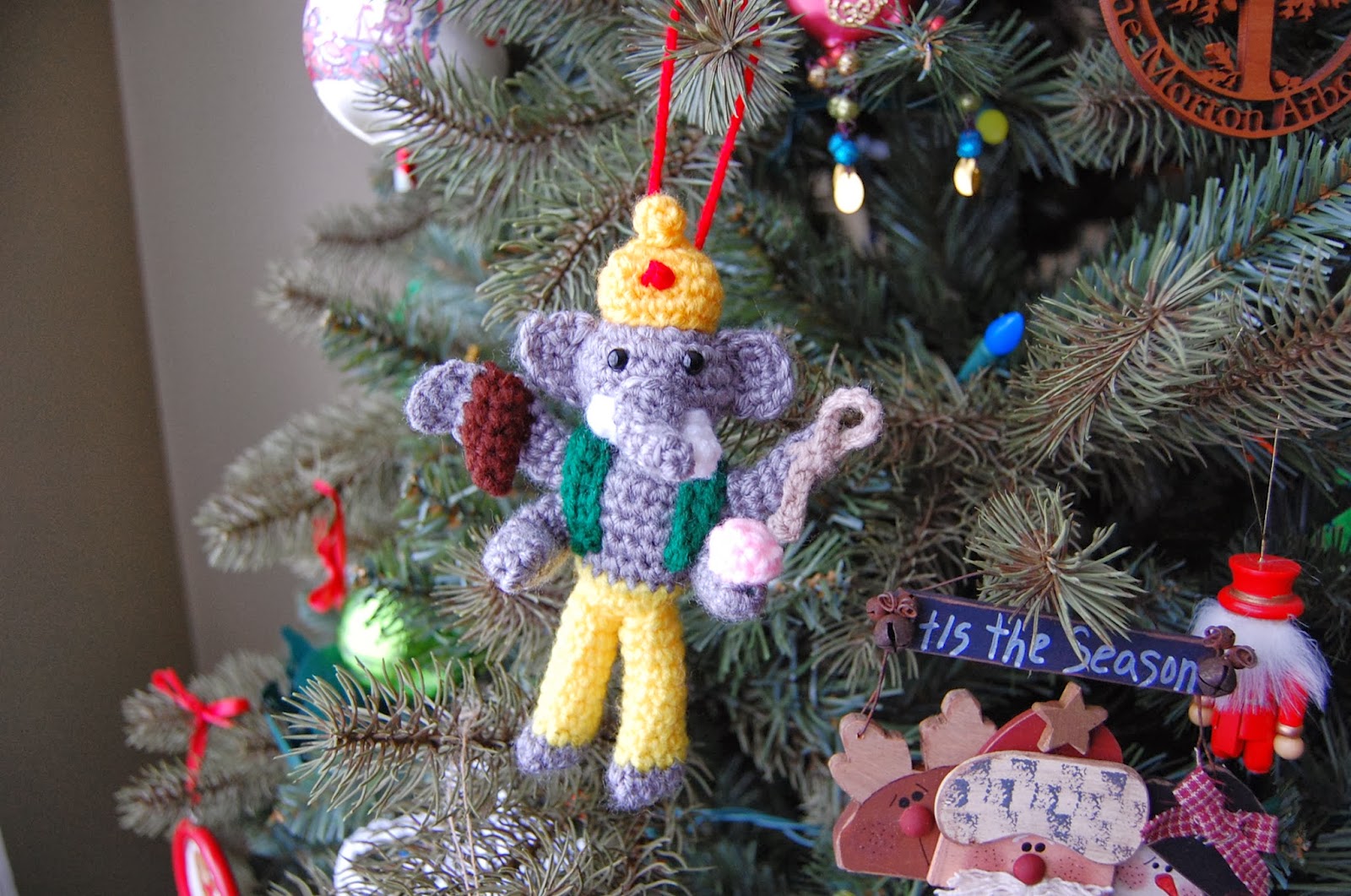
For our fabulous Hindu friends that subscribe to the "when in Rome, do as the Romans do" philosophy and celebrate a secular version of Christmas (the parents of this family are originally from India and now live in the US), I crocheted this Ganesha (a Hindu deity) and tied a hanger on it so it could be a Christmas tree ornament.  The pattern was wonderful and amazingly detailed.  I did some research on Ganesha to educate myself and I love how the pattern has him holding some of the classic items that Ganesha figures hold: an axe, a rope, and a delicacy.  This Ganesha even has the classic broken tusk.  I have to admit that Ganesha might be my favorite of all the ornaments I made.... He was so much fun!!  (Note the "'Tis the Season" wooden ornament to Ganesha's left, made by my wildly talented Aunt Janet, AKA the Roonie Ranchers' crafting hero.)


- Niki's tree received a flying pig ornament based on Lucy Ravenscar's pig pattern (remember the rainbow of piggies I made last year?) with free-handed wings.  I seriously love this tiny piggy pattern.  I'm pretty sure I've used it for at least 15 piggies at this point.


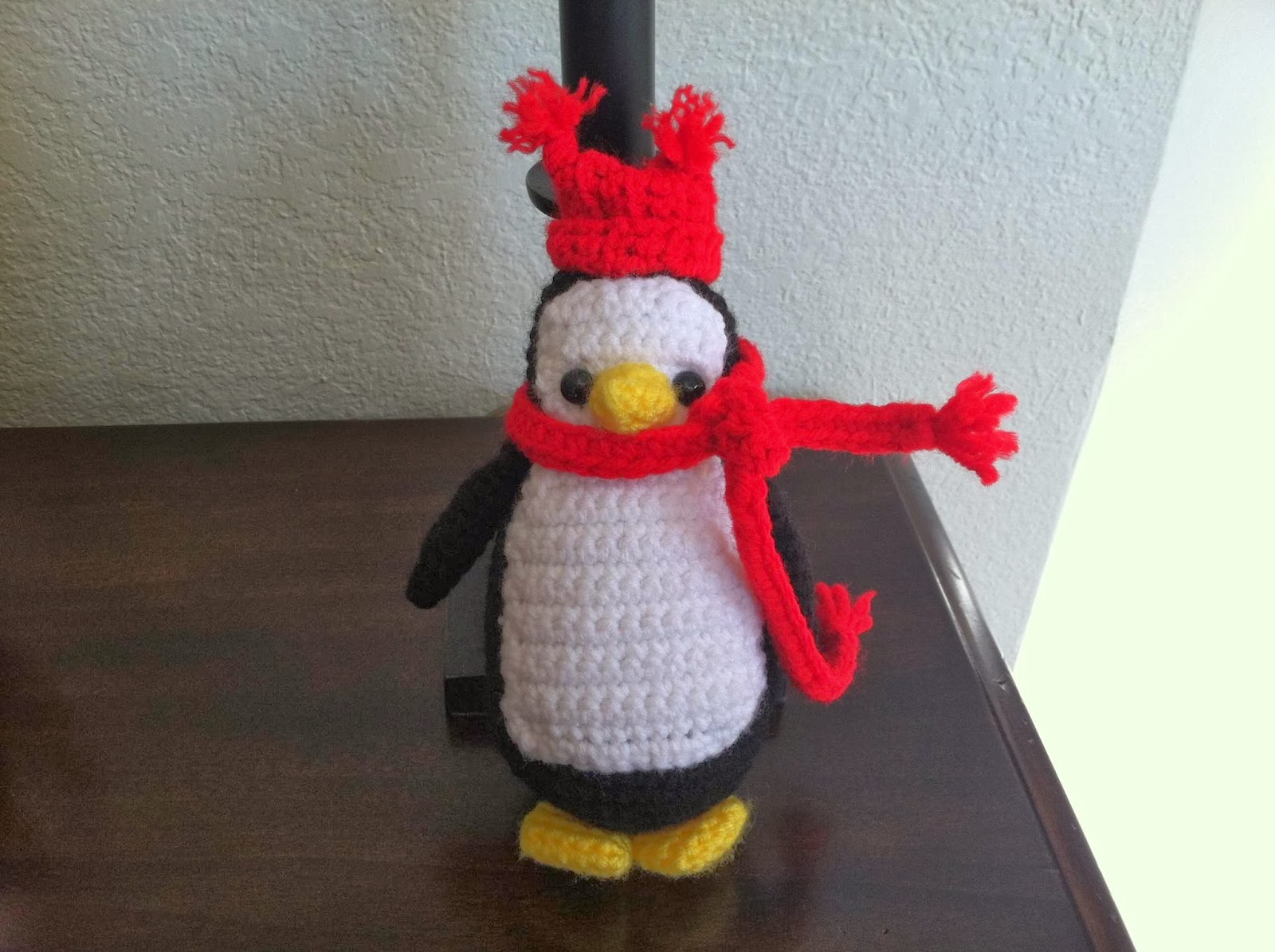
I made my nephew, Nicholas, this adorable penguin. In the picture on the pattern, he was shown as an ornament, but when I used Red Heart Super Saver worsted-weight yarn rather than the suggested sport-weight yarn, he turned into more of a small stuffed animal. All the better to cuddle with!  Not sure why the hat turned out a wee bit too small, but by the time I realized it was too small, I had already added the puffball details and was too in love with it to start over.  Now I've talked myself into thinking that it just adds to the penguin's charm.


And now for the ones with a glaring lack of pictures....  I am selfishly including these in this post just so I don't forget that I made them.

- Perhaps next year the Roonie Ranchers' mom will be able to take a quick picture of the angel I made.

- For our hilarious brother, I thought a lobster in maroon would make the perfect Christmas tree ornament.

- I gave this Santa ornament to Andrew's Aunt Anita and Uncle Bob before I took a picture of it. Whoops!!